




Ephemeris
Planet, Comet, Asteroid Observing
Deep-Sky Planner 9 provides ephemeris calculations (meaning position, magnitude, size, etc.) and 2 styles of ephemeris reporting for the major planets, sun and moon. The detailed ephemeris style is useful for viewing information for an object at a specific time, including physical ephemeris data for sun, moon, Mars, Jupiter and Saturn. The brief ephemeris style is useful for reporting changes to an object over time, such as motion, magnitude or size.
You can calculate an ephemeris for an interval that you define over any range of date and time, but ephemeris calculations lose accuracy in the distant past or future. Motion of each object over time is also calculated and reported.
Similarly, you can calculate and report the date and time of planetary phenomena (events) over a range of date and time. These phenomena include solar and lunar eclipses, lunar phases, greatest elongations (inferior planets), conjunctions/oppositions, aphelions/perihelions, equinoxes/solstices (sun).
You can also:
- compute altitude and azimuth of objects at specified date & time
- slew your GO TO telescope to the object (or sync the telescope position with the object)
- push-to using Argo Navis, Nexus DSC or Sky Commander
- show a star chart centered on the object using TheSky6/x/64, Redshift, Starry Night, Stellarium or Cartes du Ciel (see version compatibility)
- view a Digitized Sky Survey (DSS) image centered on the reported object
- view a graph of any reported object's altitude over time on the specified date
- view a graph of any reported object's altitude at a time of day over a specified year
- add observations to your log for any reported object
- view logged observations of any reported object
- print or save reports as PDF, formatted text or HTML
Video snip: Detailed Planet Ephemeris report for Saturn
on the morning of 13 June 2024
Events
Deep-Sky Planner 9 computes the date and time of various events involving sun, moon and planets. You can compute:
- Greatest Elongation of Mercury & Venus
- Conjunctions & Oppositions of planets
- Aphelion & Perihelion of planets
- Equinoxes & Solstices of the sun
- Lunar and Solar eclipses
- Phases of the Moon
These reports can be exported to several file formats including HTML, delimited text (.csv) and iCalendar (.ics). iCalendar files can be imported into most common calendar programs/ services like Apple Calendar, Google Calendar or Microsoft Outlook.
Astronomical Darkness Analysis
You can calculate and report the times of astronomical darkness (meaning that the sun is at least 18° below the horizon and the moon is down) over a range of dates. Times of sun rise/set, moon rise/set and moon phase are included. Darkness reports may be presented in either tabular text or graphically. You can also print or save reports as formatted text, HTML or delimited text (CSV.)
| -- Click to enlarge -- | |
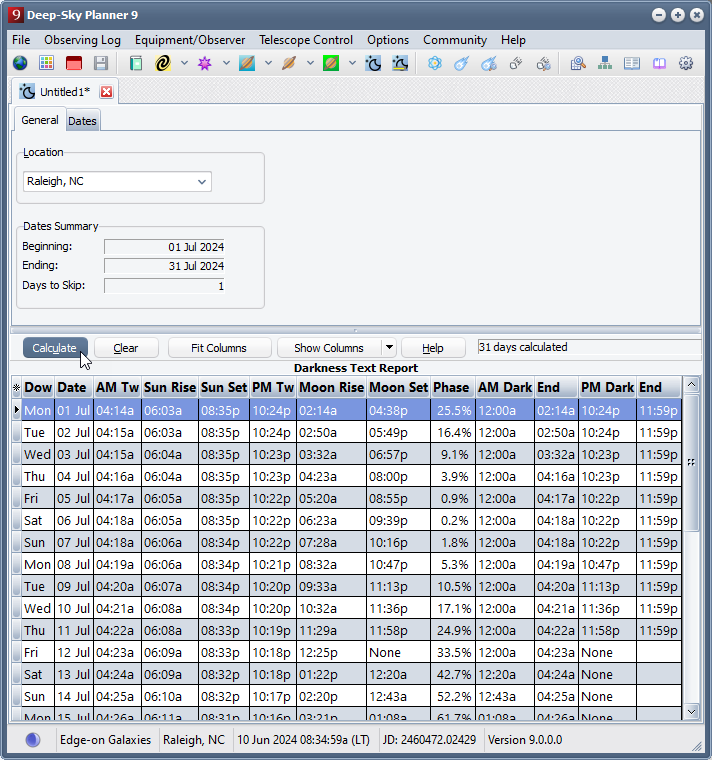 Darkness report for July 2024 |
 Graphical darkness report for July 2024 |
Many astronomical software products incorrectly report that the moon rises or sets on dates when in fact it does not. Deep-Sky Planner accurately reports no moon rise or set for these dates.
Observe Comets and Asteroids
Orbital Elements Manager
Up-to-date orbital elements are required to compute an accurate ephemeris for comets and asteroids but getting correct orbital elements is often tedious or confusing. Deep-Sky Planner addresses this with an innovative data management feature that acquires and maintains orbital elements so that your ephemeris is accurate. You can download updated orbital elements from several sources, and you can do so for groups of objects or enter elements manually for any object, including newly discovered ones. You can also determine when you last updated an object's elements. Read more in a Deep-Sky Planner White Paper.
Click to enlarge

Orbital Elements Manager
Reports
Deep-Sky Planner provides 2 ephemeris reporting capabilities for comets and asteroids: ephemeris calculations for selected objects over time, or searching for objects that meet your observing criteria for a specified date and time. The reported data include position, predicted magnitude, solar elongation, phase, rise/set/transit and best time to view.
You can also:
- compute altitude and azimuth of objects at specified date & time
- slew your GO TO telescope to the object (or sync the telescope position with the object)
- push-to using Argo Navis, Nexus DSC or Sky Commander
- show a star chart centered on the object using TheSky, Redshift, Starry Night, Stellarium or Cartes du Ciel (see version compatibility)
- view a Digitized Sky Survey (DSS) image centered on the reported object
- view a graph of any reported object's altitude over time on the specified date
- view a graph of any reported object's altitude at a time of day over a specified year
- add observations to your log for any reported object
- view logged observations of any reported object
- print or save reports to PDF, formatted text or HTML